It's Elemental

Thinking about thinking about feedback

·

, ,

The One Is EverythingOk I’ve been thinking about feedback.

One thing that struck me as interesting was that feedback, as a concept, seems to assume two things (and probably more): 1) step-wise time (and thus some kind of “state” in which a system can be identified, and thus 2) some kind of ‘levels’ within and between systems, in part based on their “state”.

So feedback, at least in the way that I’ve been thinking about it up to now, is this idea that state A of a system precipitates state B in some way, but that state B has non-trivial links ‘back’ to processes that help create state A. But of course because we are talking about the evolution of systems, this idea of ‘back’ may be better understood inversely, as ‘forward’, in the sense that there is a real distinction between state A, state B(sub-A), which is the state of system B-as-influenced-by-A, and then state A(sub-B,sub-A) the state of A-influenced-by-B-which-is-already-influenced-by-A…. And this goes on, so we have something more like a system-of-relations (S) at various points, which are distinguished by virtue of the feedback relations between its states A and B.

Here’s an attempt at a table explicating the pattern of what we mean by “feedback”:

S1 A
S2 B(A)
S3 A(B(A))
S4 B(A(B(A)))
S5 A(B(A(B(A))))

You can see the pattern unfolding infinitely — the thing is that when we think about it in this way, the pattern that is unfolding is one that does so on the basis of these ‘moments’ (S1, S2, …). But these moments are always arbitrary; there doesn’t seem to be any ontological significance to them outside of the context of their actual identification by someone thinking about cybernetics. Our knowledge of the system becomes apropos when we question it, when a need for knowledge arises… and not otherwise.

If this is true, it’s kind of misleading to have the idea of “a system” that exists “in a state” and that this state influences some other system’s state, and so forth. It’s too reductive… and it seems to fall prey to Whitehead’s fallacy of misplaced concreteness. (Others familiar with quantum physics, and specifically the Einstein-Bohr debates may see some parallels with this line of thinking.)

When thinking about TIME and evolving systems, we run into some serious complexities, because different information flows through a given portion of a system at different rates depending upon the nature of that part of the system and the nature of the information being carried. Heat flows at one speed through a specific material, at another speed through another material. Information carried by light moves still differently, as does linguistic meaning, different types of sensation, etc. etc. etc.. Just about every ‘channel’ of information has its own unique set of variables in this regard, so there is no way to divvy up a given system into “state A” or “state B” with complete certainty, because at any arbitrary snapshot point, an important bit of information from one part of the system might be ‘on its way’ but not yet resulting in any modification elsewhere in the system in a significant way — in other words feedback has an analog character. We can create digital systems in which feedback appears to operate step-wise, but this is always an oversimplification… (perhaps not if we get to the quantum level, but even then I have a suspicion that something, perhaps not either analog or digital, has a role to play in what is now left out of the loop entirely, i.e. is attributed to ‘randomness’). In any case any macroscopic digital process always (?) includes analog processes (on higher and lower levels). The point is that it is misleading to speak of “states” at all.

So what? Well, our very ability to speak about feedback seems to presuppose a conceptual reliance upon “states”. Hmmmmm. What if we got rid of “states” and started to look more at the processes? What if we slipped out of the subtle reification of “statehood” and into the flowing of flows? The processes of processes? It seems then impossible to consider anything but the whole; everything is a whole, evolves-as-whole, is-always-whole-ing, and never ‘just is’.

Mercury Thermostat
For example in an old-style mercury thermostat, the state changes from “on” to “off” to “on” again. The way it does this is through a process of feedback between the temperature of the room and the curvature of a bi-metallic strip. When the temperature is too cold (given a specific calibration point to begin with), the bimetallic strip curves in on itself, causing mercury (a conductive liquid)to fall to one side of its containing vial, where it closes an electrical circuit, making the heater go on. When the temperature is warm enough, the bi-metallic strip expands and causes the vial to tilt the other way, so that the mercury ends up in the other side of the vial, breaking the circuit and causing the heater to go off. Wash, rinse, repeat, over and over.

This is the ‘classic’ case of a feedback system. The system of the room+thermostat includes a feedback “mechanism” by which information ABOUT the “state” of the system is influential in determining the BEHAVIOR of the system. But there is something arbitrary about thinking of the system as composed of a room and a thermostat. We could divide things up into any number of different configurations, which would give slightly different perspectives on the whole. For example we can distinguish the temperature of different volumes of air, the internal components of the thermostat, the volume of air in the heating ducts and their placement, etc. “The thermostat” and “the room” are just cognitive shortcuts for more complex interrelations that, on the one hand, can be usefully summed up by such shortcuts, but which on the other hand deflects awareness from the process by which the making of the distinctions occurs, and its interactive, contingent, on-going nature. This is a general issue that crops up around epistemology.

Exploring a bit further, it would then seem that if we take such an idea to heart, it becomes much more difficult to speak of “levels” that are clear and distinct (to borrow a pithy and dangerous phrase from Descartes)–for the basis for any such distinction is some clarity about difference, and the basis for clarity is the distinction of difference. Alchemically, this is like the operation of precipitation, where a flowing, dissolving, ever-changing substance becomes punctuated by moments of particularly which separate themselves off from the activity of being-in-process with the rest of the solution. Identity becomes not only possible but fitting: here we have the formation of a crystal. It is here, it is this size, it is moving like this, it is not any of these other equally separate and identifiable crystals. (In terms of the alchemical language of process, this is the Earth element at work.)

In other words, the concept of feedback works well by virtue of its implicit reliance upon the tendency to make distinctions in complex wholes: this “part” of a system and that “part” of a system, this “state” at one time and some other “state” at another. Such distinctions may represent an a-ontological punctuation of difference within a field of activity that admits–without the activity of the distinguisher–of no such intrinsic difference. That is to say, distinctions have a certain amount of… freedom to them. Our distinguishing of one state or part of a system may not be rooted in some kind of ontologically independent “reality” which can, on its own hold up the validity of that distinction. Such validity always requires the situated contextuality of the distinguisher. (In terms of the alchemical language of process, this is the element of Water at work).
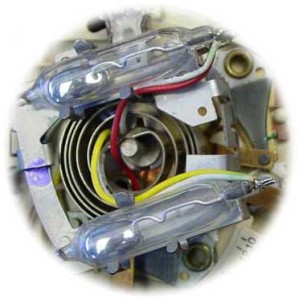
Thermostat detailOne can think of the thermostat/room system as a homeostatic one, which brings the room temperature towards some specific target through negative feedback. But this ‘stasis’ is somewhat illusory; it is accomplished by continual change. No matter how the system is constructed, it is change that creates the stasis. So it’s more accurate to think of the thermostat/room system as evolving around a cyclic attractor, where the temperature regularly fluctuates above and below a certain average (the ‘target’ temperature). It is also the stasis that creates change; the curling and uncurling of the bimetallic strip can only occur if the ambient temperature has some aspect that is constant (in this case, that the temperature STAYS above or below the target value–you’ll notice that this is a case of higher-order constancy, a constancy that is possible on the basis of change that maintains a difference).

So we sometimes make a distinction about levels: on a ‘higher’ level the system is essentially constant, while on a ‘lower’ level it is continually in flux. But again these are cognitive shortcuts for interweaving processes which do not admit of such self-distinction. The ‘levels’ are identified BY us FOR us. Just as the identification of ‘states’ is contextually contingent and not necessarily ontological, so it is with the identification of ‘levels’.

This is not to say that our distinctions are completely unguided or arbitrary–because we can’t overlook the fact that we ourselves are involved in any system by virtue of our interaction with it. Even if we are ‘just looking’ at a system, we cannot but help look with eyes that see only particularities that evolve with our ability to distinguish them. Even our seeing is cybernetic, involved in recursive looping between the ‘out there’ and the ‘in here’. The seeing is not either ‘objective’ or ‘subjective’, but partakes of both aspects, being guided by outer processes and inner processes simultaneously, and which affects the ‘seeing system’ in multiple ways, some of which may be inconsequential, and some of which may make all the difference in the world.

Other Posts

TEST

Saying that your brain “sees” is just as sensible as saying that your knee “sees.”

— Seth Miller

Act in order to know.

— Bradford Keeney

Stated simply: all that we know and are: vicious circles and virtuous circles.

— Bradford Keeney

Projection is perception.

— Michael Librie

To know yourself, change.

To know the other, change your interaction with the other.

It takes two to know one.

Cybernetics is the science of wisdom circles.

Gravity is a thing invented by Isaac Newton to explain things which otherwise require harder thinking.

— Bradford Keeney

Self-esteem is a thing invented by psychologists to explain things which otherwise require harder thinking

— Bradford Keeney

I love things complexly because they are complex.

— Jerome Ysroael Lettvin

The best way to predict the future is to invent it.

— Alan Kay

The problems of today cannot be solved by the level of thinking that created them.

— Albert Einstein

The vast majority of human beings dislike and even dread all notions with which they are not familiar. Hence it comes about, that at their first appearance, innovators have always been divided as fools and madmen.

— Aldous Huxley

We don’t see things as they are, we see them as we are.

— Anais Nin

Art is a lie that helps us to realize the truth.

— Pablo Picasso

Painting is silent poetry, and poetry is painting that speaks.

— James McNeill Whistler

The fascinating thing, is not to show the source of light, but the effect of light.

— Edgar Degas

Like an ability or a muscle, hearing your inner wisdom is strengthened by doing it.

— Robbie Gass

Good art is not what it looks like, but what it does to us.

— Elliot Eisner

That homo has a brain no more entitles him to assume he knows how he thinks than possession of a liver entitles him to assume that he knows how he metabolizes.

— Ross Ashby

No system adapts to the changing: it can adapt only to what is constant.

— Ross Ashby

Truth is a process, not a result.

— Seth Miller

Respect that which is more complicated than our ability to know.

— Bradford Keeney

The world is self-verifying.

— Bradford Keeney

Intuition, rather than being that which is dependent upon something unique to myself, is rather precisely that which I cannot claim as my own.

— Seth Miller

All of nature begins to whisper its secrets to us through its sounds. Sounds that were previously incomprehensible to our soul now become the meaningful language of nature.

— Rudolf Steiner

Love extends beyond the bounds of family to all human beings and is changed into vivifying, creative, transmuting power.

— Rudolf Steiner

What would the World be like if Newton had asked ‘Why does the tree grow up?’ as opposed to ‘Why does the apple fall down.’?

— Annette Kearl

Every claim transforms when seen from a higher order level of organization.

— Seth Miller

Creativity should not be too linked to personal desire, because the deepest source of creativity is–in the end–always found beyond the part of ourselves that initiates desire.

— Seth Miller

Passionate inquiry _IS_ creative inquiry.

— Bradford Keeney

Passion dissolves categoricals.

— Seth Miller

Play is the new metaphor of our time.

— Bradford Keeney

Honor thy error.

— Brian Eno

If you ain’t makin’ mistakes, you ain’t tryin’.

— Jazz Wisdom

Chaos is the breakdown of order… or it is order of an infinitely high degree.

— David Peat

Don’t ask what the word means, ask how it is used.

— Wittgenstein

Is the chaos the breakdown of order, or is the order a breakdown of chaos?

— David Peat

There is no psychology; there is only biography and autobiography.

— Thomas Szasz

The unconscious does not have the ability to negate.

— Bradford Keeney

Perform your vision.

— Bradford Keeney

Writing is a great mystery, because you submit yourself to the gods and you are played.

— Bradford Keeney

What is the question behind the question?

— David Peat

Alchemy never died.

— David Peat

The looking is subjective; the finding is objective.

— David Peat

What I cannot create, I do not understand.

— Richard Feynman

Since we are meaning-making creatures, any theory of meaning we concoct must be a tacit theory about who we are.

— Bruce Wilshire, The Moral Collapse of the Univeristy

The limits of the imagination are unimaginable.

— Bruce Wilshire, The Moral Collapse of the Univeristy

Education is basically a moral relationship between persons devoted to truth.

— Bruce Wilshire, The Moral Collapse of the Univeristy

As with the body, so with the world experienced by it.

— Bruce Wilshire, The Moral Collapse of the Univeristy

Can we let go of our attachment to being “right” and explore what’s left?

— Alfonso Montuori

While we see ourselves as using knowledge, it may be more accurate to say that what we know is using us: We are drawn into responding to all that occurs around us.

— Tarthang Tulku

Positions, then, are defended in an adversarial style because the positions are the spaces occupied by the self–the self IS its positions. [And then one’s] positions become impositions.

— Alfonso Montuori

The labels and ideas that structure experience will naturally also shape and guide our questioning. But recognized as labels and ideas, they lose their power to confine the range of inquiry, and instead become elements available for investigation.

— Tarthang Tulku

The attitude we adopt in carrying out our investigation shape the attributes we find in the world we investigate.

— Tarthang Tulku

Knowing limits as limits, we know them also as knowledge. Aware of the mind as the one that affirms limits, we can ask whether mind too is knowledge. If so, knowledge becomes freely available in a previously unsuspected way. Self-sufficient, self-reliant, and dynamic, the mind expresses knowledge not as content but as capacity.

— Tarthang Tulku

It’s not about the said; it’s about the SAYING. It’s not about the movement, it’s about the MOVING!

— Bradford Keeney, Personal communication, paraphase

It is impossible for a man to learn what he thinks he already knows.

— Epictetus

Metaphors are what thought is all about. We use metaphor consciously or unconsciously, all the time, so it is a matter of mental hygiene to take responsibility for these metaphors, to look at them carefully, to see how meanings slide form one to the other. Any metaphor is double-sided .. offering both new insight and new confusion. The solution is to take responsibility for the choice of metaphors, to savor them and ponder their suggestions. Above all to live with many and take no one metaphor as absolute. A metaphor goes on generating ideas and question, so that a metaphorical approach to the world is endlessly fertile and involves constant learning. A good metaphor continues to instruct.

— Mary Catherine Bateson

Rigor and imagination: the two great contraries of mental process, either of which by itself is lethal. Rigor alone is paralytic death, but imagination alone is insanity.

— Gregory Bateson

Set aside visions of the larger whole, and even of the parts, and embody the patterns in between.

— Deborah Bird Rose

The purpose of art is to lay bare the questions which have been hidden by the answers.

— James Baldwin

A way of seeing is also a way of not seeing.

— Kenneth Burke

You don’t know what you are doing until you first get lost in the doing of it.

— Bradford Keeney

Lost can be good if you dance it.

— Bradford Keeney

Question: If the Ouroborus was on fire, and he ate his tail, would he get heartburn?

— Joseph Mageary, personal communication

As we are, so we know.
As our knowing forms,
such is our becoming.

— Bradford Keeney

It is the weave of the context that holds a complexity that cannot be stripped to a singular agent.

— Bradford Keeney

I am the observed relation between myself and observing myself.

— Heinz von Foerster

‘I’ is a relator (and representor) of infinite order.

— Heinz von Foerster

Objects and events are not primary experiences. ‘Objects’ and ‘Events’ are representations of relations.

— Heinz von Foerster

An organism is its own ultimate object.

— Heinz von Foerster

Terminal representations (descriptions) made by an organism are manifest in its movements; consequently, the logical structure of descriptions arises from the logical structure of movements.

— Heinz von Foerster

The real beginning of mentality is the birthplace of error, and herewith truth.

— Heinz von Foerster

Information and its utilization are inseparable constituting one single process.

— Heinz von Foerster

The information associated with a description depends on an observer’s ability to draw inferences from this description.

— Heinz von Foerster

Change’ presupposes invariance and ‘invariance’ change.

— Heinz von Foerster

Act always so as to increase the number of choices.

— Heinz von Foerster

Humankind has not woven the web of life. We are but one thread within it. Whatever we do to the web, we do to ourselves. All things are bound together. All things connect.

— Chief Seattle

Cause and effect act in webs, not chains.

— Steve Grand

Ideas are differences that are immanent in the pathways in which they circulate.

— Bradford Keeney

What I distinguish distinguishes what I can distinguish.

— Seth Miller

Differences differentiate my differentiating.

— Seth Miller

Our distinctions, if not subject to the hands of divine play, may lead us toward creating paralyzing towers of Babel or overly simplistic mouse traps for trying to catch what matters most. In other words our ideas need a hug. There is nothing in their logic that matters. Logic is not logical in my heart. What matters is whether our ideas, distinctions, and chit chat have love and n/om, that is, are embraced in a more encompassing courtship. Even what I write is silly and misses the mark, but I am trying to point to something that accentuates living rather than re-figuring. I am saluting the use of words as incantations and evocations to liberate a theology of play and a biology of hugging. Our reason is to be kissed by the gods.

— Bradford Keeney

I never believed in trying to do anything. Whatever I set out to do I found I had already accomplished.

— Johann Wolfgang von Goethe

Rest not! Life is sweeping by; go dare before you die. / Something mighty and sublime, leave behind to conquer time.

— Johann Wolfgang von Goethe

Fresh activity is the only means of overcoming adversity.

— Johann Wolfgang von Goethe

Knowing is not enough; we must apply. Willing is not enough; we must do.

— Johann Wolfgang von Goethe

Beauty is everywhere a welcome guest.

— Johann Wolfgang von Goethe

A man should hear a little music, read a little poetry, and see a fine picture every day of his life, in order that worldly cares may not obliterate the sense of the beautiful which God has implanted in the human soul.

— Johann Wolfgang von Goethe

Boldness has genius, power and magic. Engage, and the mind grows heated. Begin, and the work will be completed.

— Johann Wolfgang von Goethe

Colours are light’s suffering and joy.

— Johann Wolfgang von Goethe

The moment one definitely commits oneself, then providence moves too. All sorts of things occur to help one that would never otherwise have occurred. A whole stream of events issues from the decision, raising in one’s favor all manner of unforseen incidents and meetings and material assistance which no man could have dreamed would have come his way.

— Johann Wolfgang von Goethe

The dangers of life are infinite, and among them is safety.

— Johann Wolfgang von Goethe

Whatever you can do or dream you can, begin it. Begin it now.

— Johann Wolfgang von Goethe

Dream no small dreams for they have no power to move the hearts of men.

— Johann Wolfgang von Goethe

For a man to achieve all that is demanded of him he must regard himself as greater than he is.

— Johann Wolfgang von Goethe

Experience is only half of experience.

— Johann Wolfgang von Goethe

None are more hopelessly enslaved than those who falsely believe they are free.

— Johann Wolfgang von Goethe

Thinking is more interesting than knowing, but less interesting than looking

— Johann Wolfgang von Goethe

One never goes so far as when one doesn’t know where one is going.

— Johann Wolfgang von Goethe

This is the highest wisdom that I own: freedom and life are earned by those alone who conquer them each day anew.

— Johann Wolfgang von Goethe

Everything in the world may be endured except continual prosperity.

— Johann Wolfgang von Goethe

Without haste, but without rest.

— Johann Wolfgang von Goethe

A man doesn’t learn to understand anything unless he loves it.

— Johann Wolfgang von Goethe

I would like to suggest that we analyze a philosophy not just for its correctness or consistency, but for its underlying metaphors, the degree of consciousness in their employment, the psychological needs met by the philosophy, its psychological distance from body, place, and world, and its consequences for how we live on this planet.

Creative transformation will reinvent the question, the questioner, and all those participating and/or reading the research.

— Bill Allison

Every fact is accompanied by the cutting edge of an epistemological knife, the wielding of which makes worlds.

— Seth Miller

Every action embodies an epistemology. An essential aspect of transformation involves awakening to the implied epistemological distinctions that are hidden within our will.

— Seth Miller

The teaching of moral development is not the same as the impulse for such development.

Cognition can never fully encompass the nature of its own activity in a description.

We do not tell stories only: we are stories.

— Craig Chalquist

What is present in thinking is always already changing the thought.

— Jeff Falzone

Questions are just assumptions that haven’t put on their pants yet.

— Jeff Falzone

Love is the only reality and it is not a mere sentiment. It is the ultimate truth that lies at the heart of creation.

— Rabindranath Tagore

All truth is absolutely relative; all truth is relatively absolute, including this one.

— Seth Miller

Distinction is also always relation at a higher level.

— Seth Miller

Without work, play is nothing, but if there is work, play is higher than work.

— Eugene Gendlin

A paradox is always a promise of a further step.

— Eugene Gendlin, How the New Can Come – phone seminar

Circularity is the destiny of any epistemology.

— Richard Jung

It is not because of compulsion from a reality outside the soul that one forms a mathematical or mechanical picture of the world, but rather because one has given shape in one’s soul to mathematical and mechanical pictures and thus opened an inner source of illumination for what manifests in the outer world in a mathematical and mechanical way.

— Rudolf Steiner, Riddles of the Soul, p. 101

All the qualities of the physical world exist through the interrelations of things to each other. What Moleschott says is correct for physical existence: “All existence is an existence through qualities. But there is no quality that does not exist through a relation.” Just as everything of a soul nature contains something in itself by which it points to something outside itself, so conversely, a physical thing is so constituted that it is what it is through the relation to it of something outer.

— Rudolf Steiner, Riddles of the Soul, p. 69

That alone is fixed and certain that is subject to change.

— C.G. Jung, Septem Sermones ad Mortuos, 1916

To be real is to be in relation.

— Seth Miller

Every action embodies an epistemology.

— Seth Miller

Any logical move is only “a move” by virtue of the distinction that it is an enactment of.

— Seth Miller

Distinction is the form of thinking; thinking is the enacting of the form of distinction.

— Seth Miller

Logic gives mathematics the ability to be true, but it is thinking which creates logic.

— Seth Miller

Living thinking explicates its implying; thoughting only implies its implying.

— Seth Miller

The fundamental pattern is the unity of the distinction between itself and unity.

— Seth Miller

Reason is a stage thinking creates for its own acting.

— Seth Miller

It is only we who can objectify our own consciousness. This should tell you something.

— Seth Miller

A concept is precisely what appears when the thinking that produces it ceases.

— Seth Miller

The “I” is the participatory event of its own coming-into-being through recursive distinction of itself.

— Seth Miller

In the “I” is the experience of the direct union of the “I’s” epistemological knowing of itself with its ontological becoming of itself.

— Seth Miller

The “I” is that place in experience where knowing and being are directly united: the epistemological content of the experience is simultaneously the realization of the “I’s” actuality, and the ontological actuality of the “I” is nothing other than the knowing of this fact.

— Seth Miller

We can only escape epistemology by being ignorant of the fact that we cannot escape epistemology.

— Seth Miller

Thinking is the activity of distinction; distinction is the activity of thinking.

— Seth Miller

How we know our knowing involves more than knowing.

— Seth Miller

Every knowing is simultaneously an unknowing. Every revealing is simultaneously a veiling.

— Seth Miller

Thinking is self-obfuscating.

— Seth Miller

The laws of nature _are_ the objects of nature.

— Seth Miller

We can change our knowing by changing our being; we can change our being by changing our knowing.

— Seth Miller

Distinction is also always relation at a higher level.

— Seth Miller

Thinking’s self-reflection IS transformation.

— Seth Miller

When thinking sleeps, objects appear.

— Seth Miller

Tautologies say nothing; Paradoxes say everything.

…to design a “computer” which computes color, shape and all that thing, which are new dimensions generated by the corpus by a series of wired-in paradoxes, which will resolve them in such a fashion that these dimensions are created. We always begin with dimension. When a dimension is created, we may have the paradox in the computation. But before you have that dimension, you have to come up with a paradox. This is of course the paradox of the first injunction. And so on and so forth; I mean, all these things come about directly by taking the paradoxes seriously and using them as a generating principle of new dimensions.

Thingness is a subset of relatedness.

— Seth Miller

The reason for reason always lies beyond mere reason.

— Seth Miller

In its knowing, epistemology always exceeds what it knows.

— Seth Miller

Every action embodies an epistemology.

— Seth Miller

How we know limits reality, and reality limits what we know.

— Seth Miller

The epistemology of difference is an ontology of evolution; the ontology of evolution is the epistemology of difference.

— Seth Miller

All polarities are also unities.

— Seth Miller

There is no distinction given by the senses alone; senses themseleves do not distiguish. The senses are what thinking makes of itself in distinguishing. The senses follow thinking. This phrase is meant both epistemologically and ontologically. But the senses are in a recursion with thinking; thinking also follows the senses.

— Seth Miller

Thinking discovers itself to be a two-fold activity at its most fundamental level: it IS what unifies the distinctions it MAKES.

— Seth Miller

Transformation becomes possible when a process cannot carry itself forward within the already-existing mode of its integration with the whole.

— Seth Miller

The stopping of a process is its continued implying at a new level.

— Seth Miller

The whole is newly whole by virtue of the part created from it.

— Seth Miller

The only valid move for the ‘undifferentiated-all-one’ is self-differentiation.

— Seth Miller

One never goes so far as when one doesn’t know where one is going.

— Johann Wolfgang von Goethe
Advertisements