

Feb
02
2010
I was asked to draw my dissertation (which is in its beginning stages).
Here's what happened:

Nov
12
2009
Bifurcations are "splits" in the way a system develops from one state to the next. Think of them as two roads diverging in a yellow wood; one leads to some unknown mystery. The other leads to MILKSHAKES (stay tuned).
My understanding is that bifurcations are always relative (did that paradox slip by you?); depending upon...

Sep
28
2009
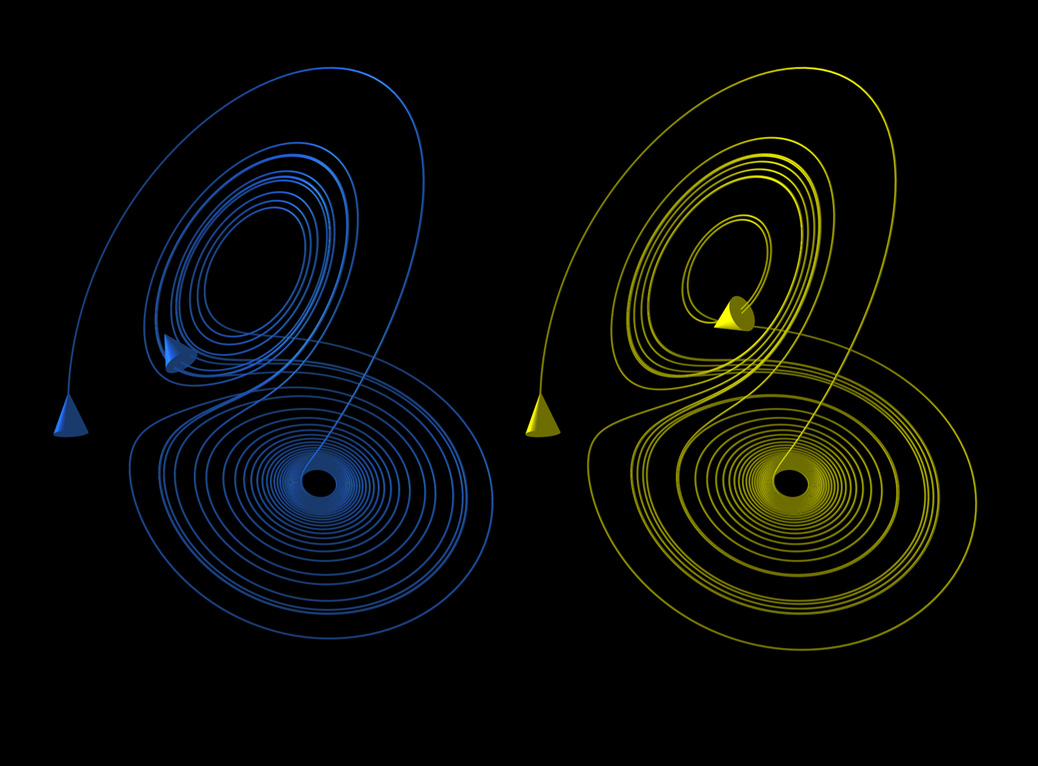
A response to the question: "How is chaos theory non-determinant?"
This is an interesting question, because I think it might normally be asked in the opposite way: "How is chaos theory DETERMINANT?", because chaos theory is, well, chaotic, so it seems more logical to connect chaos with non-determinancy than with determinancy.
So to explore the question that wasn't...
Sep
26
2009
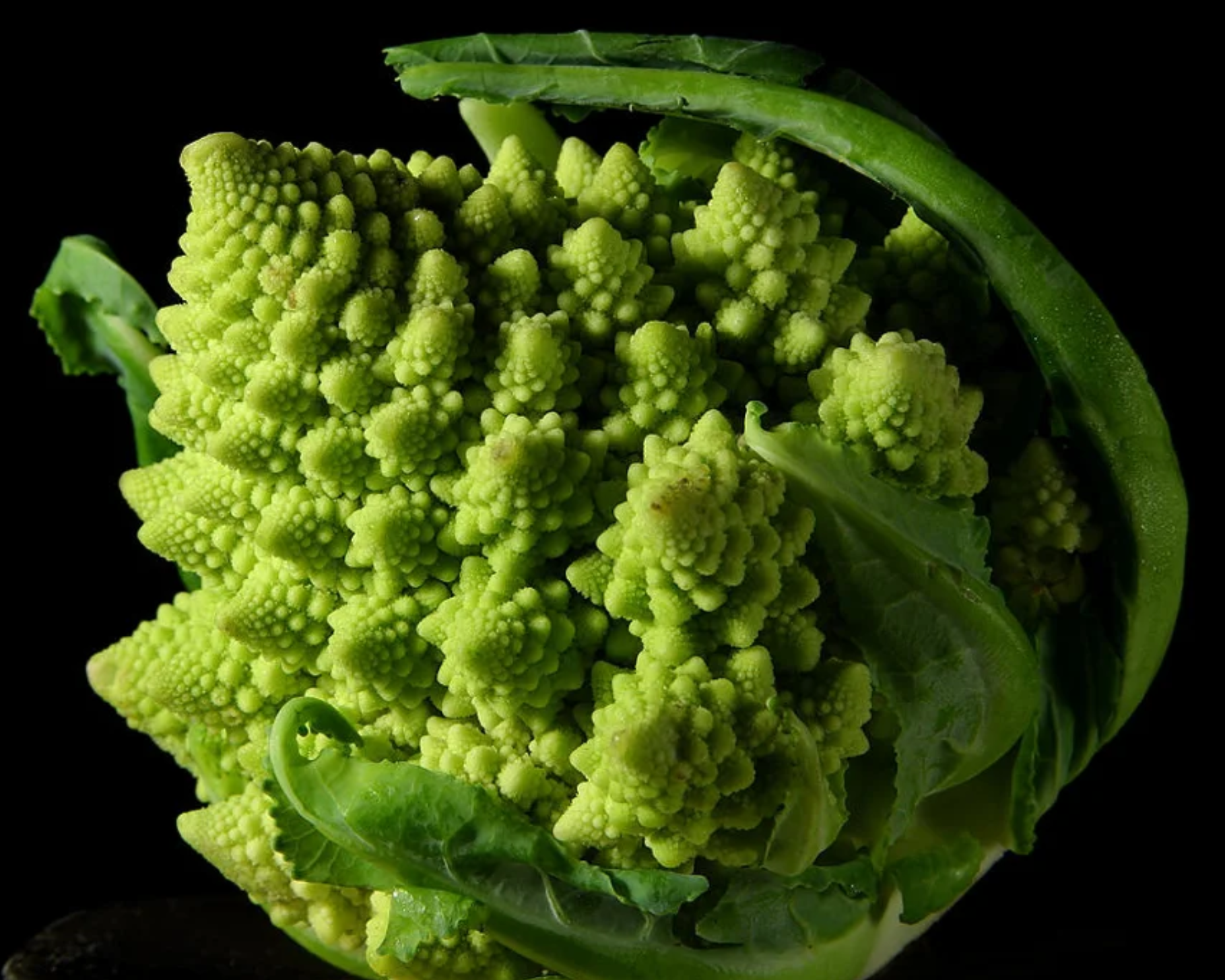
4. I don't understand how the butterfly effect looks like the structures seen in the book...a butterfly looking pattern.
The butterfly effect is just the name, slightly arbitrary, of the idea that complex systems exhibit the characteristic by which tiny tiny tiny (infintesimally tiny) changes in one part of the system have the potential (not...
Sep
24
2009
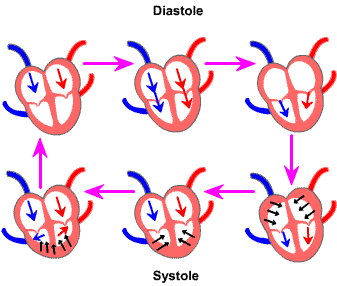
3. And so, there's all this talk about 'deterministic chaotic systems'... What exactly, is the stunning significance of this? I think I get that every shape in nature is ultimately created by patterns of itself within itself, but I'm confused as a biologist or physiologist or biochemist because things like continents are made of...
Sep
22
2009
2. Does the fractal model also work for dynamic, fluid or changing shapes?
Yes, in fact this is it's most 'natural home' I think. The reason is that fractals are about processes, not things, and processes are just that: descriptions of changes, not of things, and changes have a way of, well, being DIFFERENT the...

Sep
20
2009
The following four questions (one per post) were posed in a recent class. My edited responses follow.
1. So I understand that any shape in nature can be converted to a mathematical formula, right? Then you take that formula and plug in the variable related to that shape and feed the answer into the variable...
Feb
15
2009
One of the things about complexity/chaos theory is that prediction submits to very specific limits, in the sense that with anything but a VERY simple system, we must give up the potential for long-term predictive certainty. This is because very small differences can lead towards extremely large differences later down the line, and we...